Moscow's official Transport Museum is opening its permanent home in 2026, and the venue alone makes it worth the visit. The collection of more than 250 full-scale vehicles — cars, buses, trolleybuses, municipal machinery, motorcycles and bicycles — will occupy the former bus garage at Novoryazanskaya Street No. 27, a Constructivist landmark designed by Konstantin Melnikov with engineer Vladimir Shukhov in the late 1920s. The building is as much an exhibit as the vehicles inside.
This is the city's official transport collection, distinct from the private Retro Car Museum elsewhere in Moscow. It tells the story of how Muscovites moved through their city over the past century, from horse-drawn trams to electric trolleybuses. The garage itself represents a brief, radical moment in Soviet design when industrial buildings doubled as architectural manifestos.
Why the Melnikov Garage Matters
Konstantin Melnikov is one of the most recognizable names in Russian avant-garde architecture. His cylindrical house on Arbat still draws architecture students. The Novoryazanskaya garage, built between 1926 and 1929, shows his signature approach: bold geometric forms, efficient use of space, and a refusal to hide function behind ornament.
The structure served Moscow's expanding bus fleet during the rapid industrialization of the 1930s. Shukhov's engineering allowed large, column-free interior spans — critical for maneuvering buses. Decades later, the building fell into disrepair. Its restoration and conversion into a museum preserves both the architecture and the vehicles that once filled garages like it across the city.
Melnikov's work is rare. Many of his projects were never built, and some that were have been demolished or altered. The garage on Novoryazanskaya is one of the few intact examples of his industrial buildings. Walking through it offers a direct encounter with Constructivist thinking: form follows function, and beauty emerges from honest structure.
What Will You See Inside the Museum?
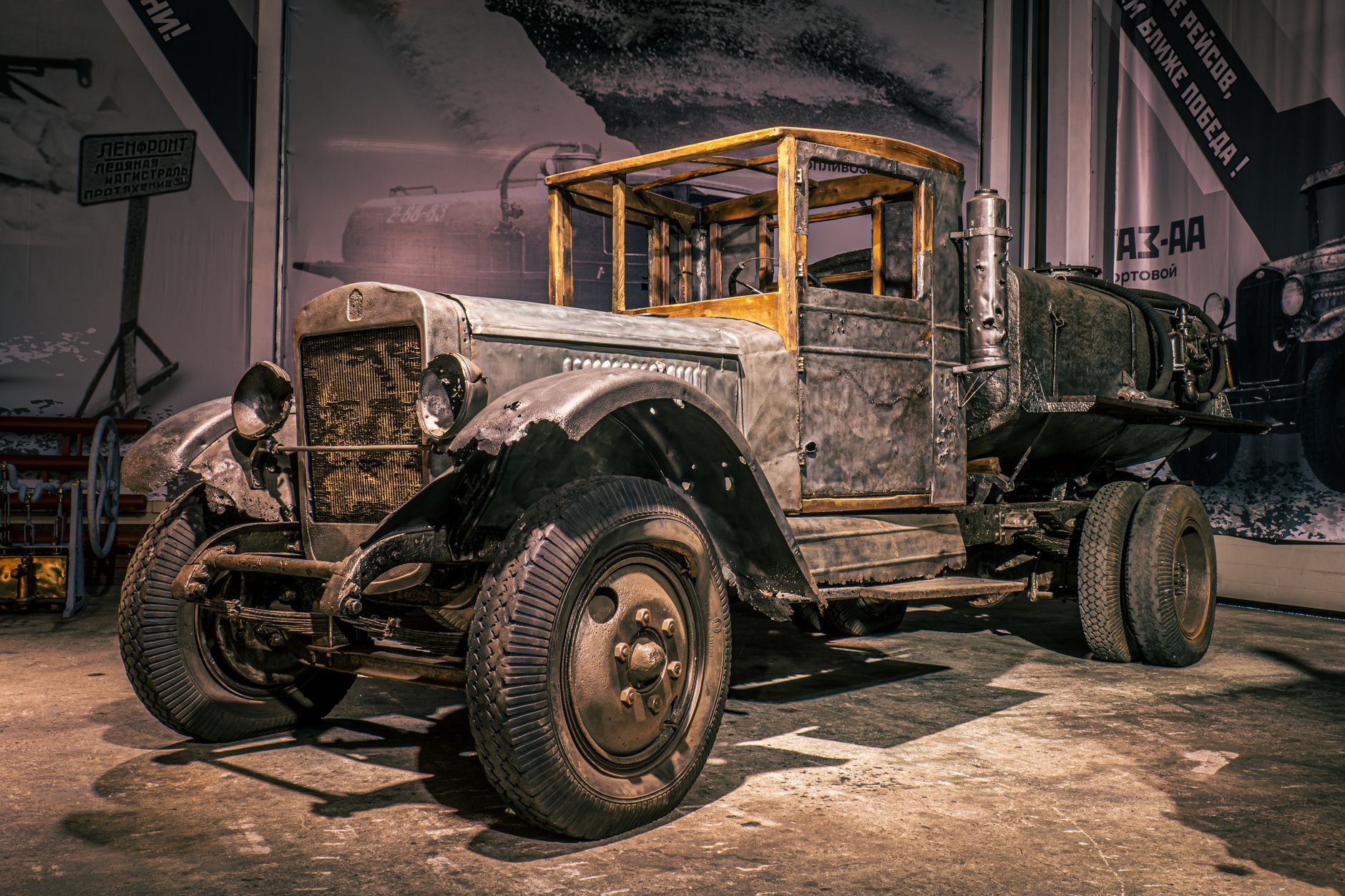
The permanent exhibition spans Moscow's transport history through more than 250 vehicles and related objects. Among the first pieces already in place are the futuristic R1 (Russia One) concept tram and the Tatra T3SU, the most common tram in the USSR, plus the Hungarian Ikarus-280 and the RAF-976 bus. Special vehicles include a PMZ-17 fire engine, a RAF-22031 "Latvia" ambulance, a Polish Star 28 lift truck, and a ZiL-157K PARM mobile repair workshop. A centerpiece is a monumental mosaic rescued from the former Moskvich car plant: 96 square meters and 7.5 tons, depicting the factory's history, restored and installed inside the garage. Early exhibits also include horse-drawn trams and the first motorized buses that replaced them. Mid-century sections feature the ZiS and ZiL models produced at Moscow's Likhachev Plant, which supplied much of the city's bus and truck fleet.
Trolleybuses occupy a significant portion of the collection. Moscow's trolleybus network, at its peak, was one of the world's largest. The museum preserves examples from different eras, showing how design and technology evolved. Municipal service vehicles — street sweepers, snowplows, delivery vans — illustrate the less glamorous but essential side of urban transport.
Motorcycles and bicycles round out the collection. Soviet-era motorcycles, many built at the Irbitsky Motorcycle Plant in the Urals, were workhorses for couriers and police. Bicycles, though less central to Moscow transport than in some European cities, had their own niche, particularly in the pre-war years.
The layout takes advantage of the garage's open interior. Vehicles are arranged thematically and chronologically, with room to walk around each exhibit. Informational panels provide context: production numbers, route histories, technical specifications. Some vehicles are positioned as if ready to roll out for a shift, evoking the building's original purpose.
How Do I Get to Novoryazanskaya Street?
The museum sits in the Lefortovo District, east of the city center. Novoryazanskaya Street runs parallel to the Yauza River, a few blocks south of Baumanskaya metro station on the dark-blue Arbatsko-Pokrovskaya line. From Baumanskaya, it's a ten-minute walk southeast.
If you're coming from central Moscow — Red Square, Tverskaya Street, or Arbat — expect a 20-minute metro ride. Change at Ploshchad Revolyutsii or Teatralnaya if you're starting from the red line. The neighborhood around the museum is quieter than the tourist core, with fewer crowds and a more residential feel.
For visitors arriving from Sheremetyevo, Domodedovo, or Vnukovo airports, GetTransfer.com offers direct rides to the museum area. A private transfer saves the effort of navigating metro transfers with luggage and drops you a short walk from the entrance. If you're planning a full day of museums, starting here and moving west toward the Tretyakov Gallery or Gorky Park keeps the itinerary logical.
When Will the Museum Open, and How Much Are Tickets?
Deputy Mayor Maksim Liksutov has said the museum was planned to open around late 2025 or early 2026, and it remains on track for 2026. As of May 2026, crews are moving large vehicles into the hall and installing exhibits, with final lighting and finishing work still under way, so an exact public opening date has not been confirmed. Ticket prices and operating hours will be announced closer to the launch. For the most current information, check the official transport.mos.ru site, which serves as the authoritative source for city transport initiatives and museum updates.
If you prefer a guided experience, GetExperience.com will offer tours once the museum opens. A guide can provide deeper context on vehicle models, the building's restoration, and the broader history of Moscow's transport network. Tours are particularly useful if you're interested in the technical side — engine types, route maps, production quirks — that static labels don't always cover.
The pass often includes or discounts entry to major city museums, and the Transport Museum may join that list given its official status.
What Else Should I Know Before Visiting?
This is not the Retro Car Museum, a private collection located elsewhere in Moscow. That museum focuses on vintage automobiles in pristine condition, often Western imports. The Transport Museum on Novoryazanskaya is the city's official institution, emphasizing working vehicles that shaped daily life rather than collector's rarities.
The Melnikov building itself warrants attention. Arrive early enough to walk the perimeter before entering. Notice the facade's rhythm of windows and the way natural light was engineered into a space designed for machinery. Inside, look up: the roof structure, largely original, shows Shukhov's signature lattice work.
Photography is generally permitted in Moscow museums unless posted otherwise, but flash can be restricted to protect exhibits. If you're documenting the architecture, morning light through the east-facing windows creates strong contrasts. The interior's industrial scale makes wide-angle lenses useful.
Plan at least two hours for a thorough visit. Enthusiasts — particularly those interested in Soviet industrial design or urban history — may want three. The neighborhood has limited dining options compared to central Moscow, so consider eating before you arrive or bringing snacks.
Common Mistakes to Avoid
Many visitors assume all Moscow museums cluster near Red Square or along Tverskaya. The Transport Museum sits east of that tourist corridor, and the trip requires a deliberate plan. Don't tack it onto a Kremlin morning and expect a quick metro hop — budget travel time.
Another pitfall: confusing this museum with the Retro Car Museum or assuming they're branches of the same institution. They're unrelated. The Retro Car Museum showcases polished collector vehicles. The Transport Museum tells a civic story through buses, trolleybuses, and service trucks. If you want gleaming chrome, go to the former. If you want to understand how Moscow moved millions of people daily, come here.
Finally, don't skip the building's exterior. Some visitors rush inside and miss the architecture that makes the venue significant. The garage is a museum piece itself. Walk around it. Notice the corner details and the way Melnikov balanced industrial pragmatism with geometric boldness.
Fitting the Museum Into a Moscow Itinerary
The Transport Museum pairs well with other Soviet-era or industrial heritage sites. The nearby Baumanskaya area includes Constructivist apartment blocks and the Yauza River embankment, a pleasant walk in good weather. Further afield, the VDNKh exhibition complex showcases Soviet ambition on a grander scale, with pavilions, fountains, and the Cosmonautics Museum.
For a contrast, head west after your visit toward Gorky Park or the Tretyakov Gallery. The juxtaposition — avant-garde industrial design in the morning, classical Russian art or green space in the afternoon — captures Moscow's layered identity. The city's metro system, an architectural marvel with stations like Mayakovskaya and Komsomolskaya, ties these experiences together.
The pass simplifies budgeting and entry logistics, particularly if you're visiting multiple sites over several days.Even without formal inclusion, the Transport Museum's location makes it an easy add-on to an eastern Moscow day.
Why This Museum Matters Now
Moscow's transport network is one of the world's busiest. The metro alone carries more than seven million passengers on an average weekday. Buses and trolleybuses fill gaps the metro can't reach. Understanding how that system developed — the vehicles, the infrastructure decisions, the industrial capacity required — adds depth to the experience of moving through the city today.
The museum also preserves a specific moment in design history. Constructivism lasted barely a decade before Stalinist monumentalism replaced it. Melnikov's garage, Shukhov's towers, and a handful of other structures are what remain. Each opening or restoration is an opportunity to see what Soviet architects imagined before politics constrained them.
For visitors interested in industrial heritage, urbanism, or 20th-century design, the Transport Museum offers something most Moscow itineraries omit: a ground-level view of how ideology, engineering, and daily necessity intersected. The vehicles inside are not just relics. They're evidence of how a city tried to solve the problem of mass movement during a century of rapid change.
Check mos.ru for updates as the opening date approaches, and consider arranging your visit through GetExperience.com if you want expert commentary. The museum will be a significant addition to Moscow's cultural landscape, and the Melnikov building ensures it will be architecturally memorable long before you read the first exhibit label.


